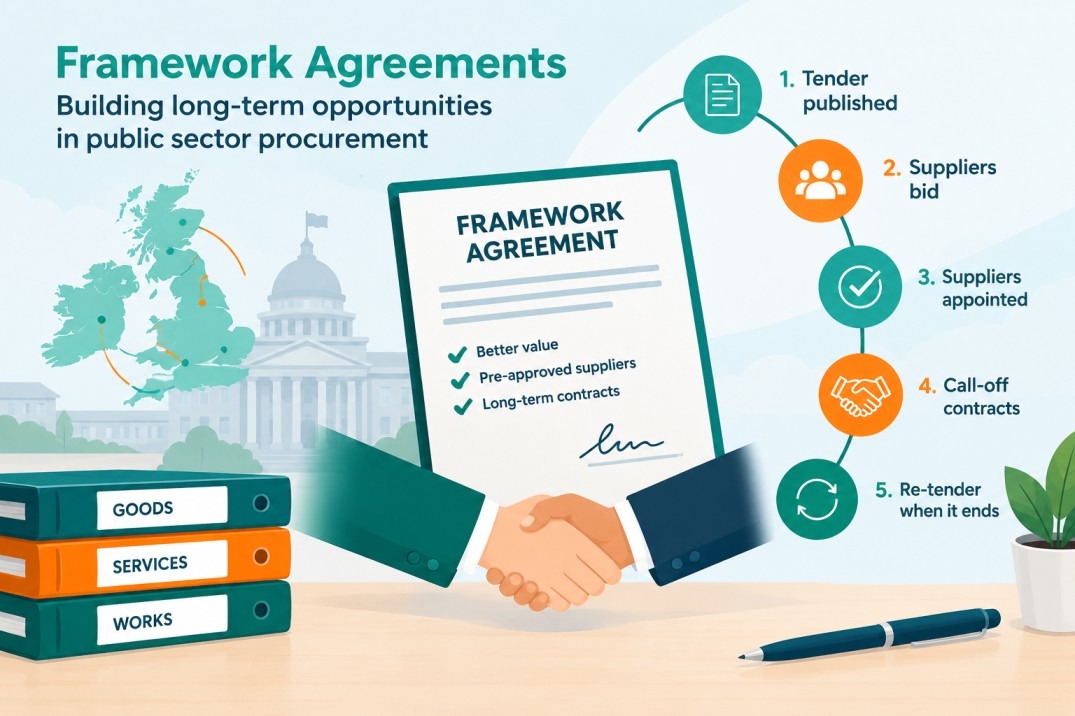
Learn how public sector framework agreements work under the Procurement Act 2023. Discover call-offs, mini-competitions, and practical tips to win repeat work.
How Do Framework Agreements Work?
Framework agreements are one of the most common ways UK and Irish public sector buyers purchase goods, services and works. For suppliers, they can mean years of repeat business, but they are also competitive to win and easy to misunderstand. This guide explains what a framework agreement is, how it works, the different types, how work is awarded, and how to secure and make the most of a place.
Key takeaways
New UK procurements are governed by the Procurement Act 2023, live since 24 February 2025.
What Is a Framework Agreement?
A framework agreement is a long-term arrangement between one or more public sector buyers and one or more suppliers. Instead of buying something outright, the buyer sets up a framework that fixes the ground rules, such as pricing, quality standards and delivery terms, for purchases made over a set period.
In the UK, frameworks are now defined under the Procurement Act 2023, which came into force on 24 February 2025 and replaced the Public Contracts Regulations 2015 for new procurements. The Act treats a framework as an agreement that provides for the future award of contracts to one or more suppliers. Ireland continues to operate under its EU-derived procurement regulations, where the same core concept applies.
Frameworks can be run by a single buyer or by a central purchasing body acting for many buyers at once, such as Crown Commercial Service, ESPO or YPO in the UK, or the Office of Government Procurement in Ireland.
The key point to understand is that being on a framework is an opportunity, not a guarantee. The buyer is not committing to any particular volume of work. They are simply creating a pre-approved, pre-vetted route they can use whenever a need arises.
How a Framework Agreement Works
How long do framework agreements last?
Under the Procurement Act 2023, most frameworks can run for up to four years. Frameworks for defence and security and for utilities can run for up to eight years, as can open frameworks (see below). Longer terms need a clear justification.
Types of Framework Agreement
Single-supplier vs multi-supplier frameworks
Single-supplier frameworks appoint one supplier for the whole term, and every order goes to them directly. These suit highly specialised or niche services.
Multi-supplier frameworks appoint several suppliers. Buyers either award work directly based on pre-agreed terms or run a mini-Competition among members for a specific requirement. This is by far the more common model.
Closed vs open frameworks
Traditionally, frameworks have worked like closed clubs: once the supplier list is set, it stays fixed for the life of the agreement. The Procurement Act 2023 introduced open frameworks, which reopen at set points to let new suppliers join part-way through, and can run for up to eight years. If you missed the original tender, an open framework may give you a second chance. Always check whether a framework you are eyeing is open or closed.
How Suppliers Get Work: Call-Offs and Mini-Competitions
Winning a place on a framework is only the first step. Revenue comes from contracts awarded under it, known as call-offs. The framework terms determine which route a buyer uses.
Direct award
Some frameworks allow the buyer to award work straight to a supplier, for example the one ranked highest or offering the best fit, without a further competition. Suppliers with the strongest positioning under the framework criteria benefit most.
Mini-Competitions
More often, buyers invite framework members to compete for a specific requirement in a short, focused bidding round, often on a tight deadline. This is where most of the real work is decided. Suppliers who do well tend to have reusable response templates and pricing models ready, a team that can mobilise quickly, and answers that stay sharply relevant to the brief rather than generic.
Framework Agreement vs DPS and Dynamic Market
Frameworks, DPSs and dynamic markets all pre-qualify suppliers for recurring needs, but they behave quite differently:
| Closed framework | Open framework | DPS / dynamic market | |
| Can new suppliers join later? | No, the list is fixed at award | Yes, at set points during the term | Yes, at any time |
| Time limit | Generally, up to 4 years (8 for defence and utilities) | Up to 8 years | No fixed maximum; stated in the notice |
| Number of suppliers | Can be capped | Set by the buyer | Unlimited |
| Best suited to | Predictable, longer-term or more complex needs | Long-term needs in changing markets | Standard, fast-moving requirements |
| How work is awarded | Direct award or mini-competition | Direct award or mini-competition | Competition among members |
A framework takes more upfront work to win than a DPS, and it does not guarantee revenue once you are in. But a single framework win can open the door to years of steady, repeat work. Read our DPS guide for more on the open, rolling alternative.
Benefits and Drawbacks of Frameworks for Suppliers
Benefits
Drawbacks
How to Get on a Framework
Winning a place is competitive, and buyers screen for far more than price. A structured approach helps:
Making the Most of Your Place
Winning a place is an achievement, but it is only the beginning. Suppliers who convert framework membership into revenue usually do the following:
Common Framework Mistakes to Avoid
Frequently Asked Questions About Framework Agreements
What is a framework agreement in simple terms?
It is a pre-agreed arrangement between public buyers and approved suppliers that sets the terms for future contracts. Buyers then award individual contracts under it as their needs arise.
How long does a framework agreement last?
Most last up to four years. Defence, utilities and open frameworks can run for up to eight years.
Does being on a framework guarantee work?
No. Buyers are not obliged to spend any set amount, and suppliers still need to compete and perform to win call-offs.
What is the difference between a closed and an open framework?
A closed framework has a fixed supplier list from the start. An open framework reopens at set points so new suppliers can join, and can run for up to eight years.
What is a mini-competition?
A short bidding round in which a buyer invites framework members to compete for a specific contract, usually judged on price and quality.
Can small businesses get on frameworks?
Yes. Many frameworks are divided into lots, and SMEs can bid for the lots that suit them, partner with other suppliers, or work as subcontractors to framework members.
Are frameworks still used under the Procurement Act 2023?
Yes. The Act keeps frameworks and adds open frameworks, while replacing the DPS with dynamic markets for new procurements.
The Takeaway
A framework agreement gives suppliers a structured route into recurring public sector business, built around long-term relationships rather than one-off bids. It takes more upfront work to win than a DPS, and it does not guarantee revenue once you are in. But for suppliers who prepare well and treat every call-off seriously, a single framework win can open the door to years of steady, repeat work with public buyers.
Find your next opportunity with Tenderbase
Tenderbase helps businesses find, track and win public sector contracts across the UK and Ireland, with Tender Management, Market Insights and Bid Services in one platform. Visit tenderbase.co.uk to get started.
Tenderbase empowers businesses to find and win public sector tenders in the UK. With a user-friendly platform, personalized dashboards, and expert support, we simplify the tender process and fuel business growth. Join us and unlock the potential of Public Sector contracts for your success.
LEARN MORE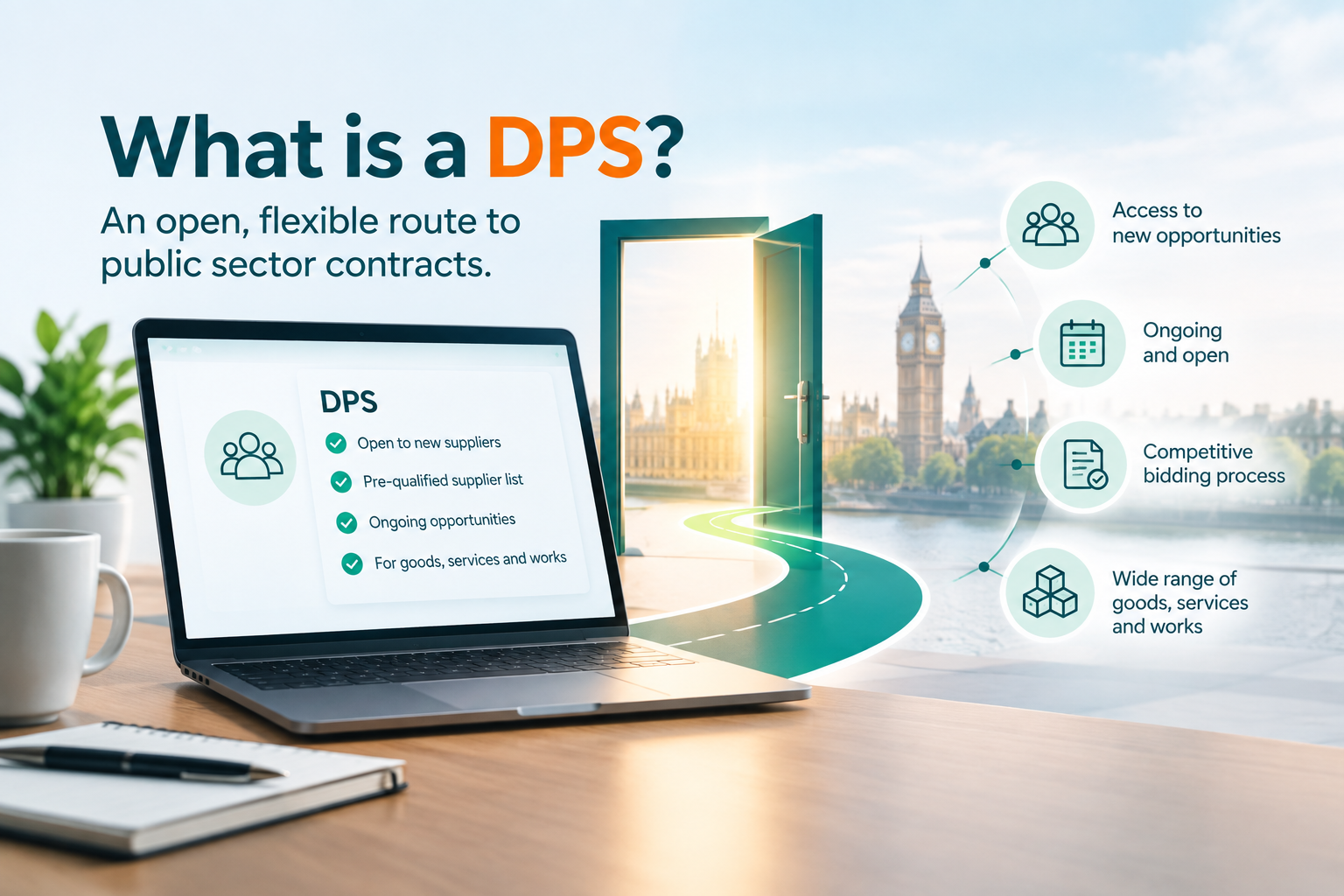 Technical
 Technical
Looking for guides, articles or something more specific? Browse all our posts by topics


Looking for guides, articles or something more specific? Browse all our posts by topics.
Tender Search
Important Information
Get to know more about our latest features.
Social Links :